

Home
Shop

Hot deals just for you this weekend

HITECH Honored at RISO India Channel Partner Meet 2025

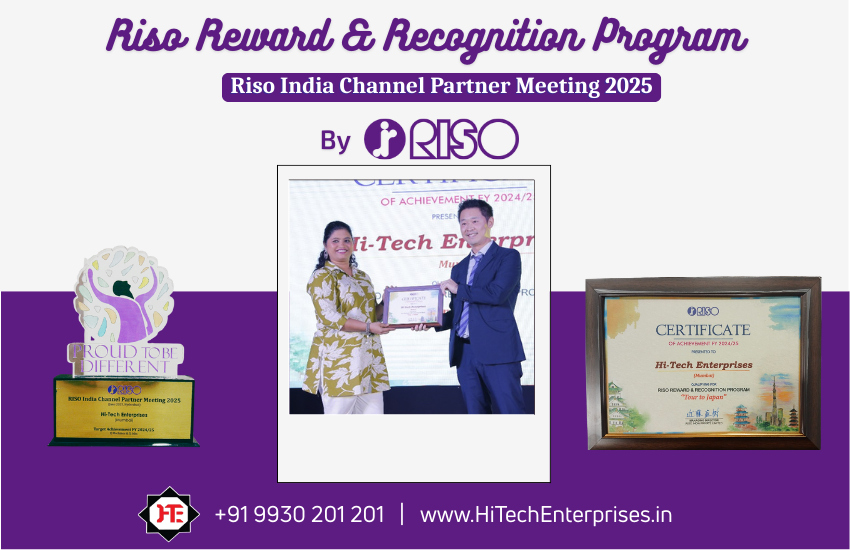
   We are proud to announce that HITECH has been recognized at the prestigious RISO India Channel Partner Meeting 2025 for our outstanding sales and service performance. Adding to the excitement, our achievement has also earned us a place in the exclusive “Tour to Japan” Recognition Program. 🇯🇵

This milestone reflects not only our consistent growth but also the trust our customers and partners place in us.

What is a RISO Partner?

A RISO Authorized Distributor for Mumbai region it’s a trusted channel associate empowered to promote, sell, and service RISO’s advanced variable printing press machines.

As a RISO partner, Hi-Tech Enterprises delivers:

  • High-speed digital duplicators for large-volume printing
  • Energy-efficient inkjet printers for modern offices
  • Reliable service & maintenance to keep operations smooth

This partnership ensures that Indian businesses, Education Institue, Hospitals and government organazation have access to cutting-edge printing innovations.

About RISO – Innovation from Japan

Founded in Japan, RISO KAGAKU Corporation is a global leader in printing technology, famous for:

  • High-speed digital duplicators trusted in schools and universities worldwide
  • Eco-friendly inkjet printers that reduce energy costs and environmental impact
  • Durable, low-maintenance machines designed for large-scale operations

From education boards to government departments, RISO machines are synonymous with speed, efficiency, and dependability.

👉 Learn more about RISO’s global journey here.

Why This Award Matters

Being recognized at the RISO India Channel Partner Meet 2025 (Hydrabad) reaffirms Hi-Tech Enterprises’ role as a leading channel partner in India.

This recognition means:

  • We consistently achieved sales & service excellence
  • Our customers receive priority support & the latest RISO technology
  • We are among a select few invited to experience RISO’s innovation at its headquarters in Japan

It’s a milestone that strengthens our bond with RISO and our customers.

How Customers Benefit from This Achievement

Awards are not just for us—they directly benefit our clients. Here’s how:

  1. Exclusive Access → Priority in getting the latest RISO products in India.
  2. Expertise & Training → Our team receives advanced training straight from RISO.
  3. Better Service → Award-winning service means faster response times & better uptime for your machines.
  4. Trusted Partnership → You work with a provider recognized globally for excellence.

Hi-Tech Enterprises: 18+ Years of Trust

Since 2006, Hi-Tech Enterprises has been India’s trusted partner for office automation and IT solutions. Our portfolio spans across:

  • Printers & Copiers (RISO, Canon, HP, Epson)
  • ID Card Printers & Security Systems (Evolis)
  • Shredders, Projectors, Laptops & Office Machines
  • Sales, AMC Services, and Rentals

With 1000+ happy clients across education, banking, healthcare, government, and corporates—we continue to deliver trust, transparency, and technology.

Industry Applications of RISO Printers in India

  • Education: Universities and schools use RISO duplicators for fast exam paper printing.
  • Government: Ministries rely on RISO for secure, large-scale document handling.
  • Corporates: Companies cut costs with RISO’s energy-efficient inkjet systems.
  • Banks & Institutions: Bulk printing for statements and ID documentation.
  • Hospitals: 

FAQs

Q1. What makes RISO printers different from others?
RISO printers are designed for speed, cost-efficiency, and eco-friendliness, making them ideal for bulk printing.

Q2. Why choose a RISO Channel Partner like HITECH?
Because you get authentic products, priority service, and expert guidance.

Q3. Are RISO machines suitable for small businesses too?
Yes, while they excel at bulk printing, compact inkjet models are also available for SMEs.

Q4. Do you offer rentals or AMC for RISO machines?
Absolutely—we provide sales, service, AMC, and rental options tailored to client needs.

Conclusion & Call-to-Action

Winning the RISO India Channel Partner Award 2025 is a proud moment for HITECH but it’s also a promise. A promise to deliver world-class printing technology, unmatched service, and dependable solutions to our customers.

📞 Ready to upgrade your office or institution with RISO printers?
Get in touch with us today at +91 9930 201 201 or visit HiTechEnterprises.in

HITECH Recognized as Evolis Elite Partner for the 4th Time on Evolis’s 25th Anniversary

Introduction: A Double Celebration 🎉

2025 marks a proud moment for us at HITECH. We are delighted to announce that we’ve been awarded the Evolis Elite Partner title for the fourth time, an honor that reflects our commitment to delivering world-class ID card printing solutions across India.

What makes this recognition even more special is its timing it coincides with Evolis’s 25th Anniversary. For a quarter of a century, Evolis has been a pioneer in ID card printing technology worldwide. And for nearly two decades, Hi-Tech Enterprises has been bringing those innovations to Indian businesses, schools, hospitals, and government institutions.

This award is not just a badge for us it’s a promise of quality, service, and trust for every customer who chooses Hi-Tech Enterprises.

What Does the Evolis Elite Partner Title Mean?

The Evolis Elite Partner status is not handed out lightly. It is a recognition given to select channel partners who have:

  • Demonstrated expertise in selling and servicing Evolis products
  • Maintained a strong track record of customer satisfaction
  • Provided specialized support, training, and after-sales services
  • Consistently promoted the Evolis brand in their region
  • In simple words, this certification means that when you work with Hi-Tech Enterprises, you’re working with a partner that Evolis itself trusts to represent its brand.

Why This Milestone Matters

Being recognized as an Evolis Elite Partner is significant but winning it four times sets Hi-Tech Enterprises apart. It shows consistency, not just one-off excellence.

Pair this with Evolis’s 25-year journey in revolutionizing card personalization solutions, and the award becomes a symbol of mutual trust, growth, and long-term vision.

For our customers, it means you’re choosing a partner who is not only experienced but also globally recognized for quality and reliability.

How This Benefits Our Customers

Awards are great but what do they mean for you as a customer? Here’s how our Elite Partner status translates into real advantages:

  • Priority Access to Evolis Products – Be the first to benefit from the latest Evolis printers, software, and accessories.
  • Enhanced After-Sales Support – Faster service, quicker turnaround times, and genuine spare parts.
  • Expert Consultation & Training – Our team receives direct training from Evolis, which means better guidance for your organization.
  • Assurance of Authenticity – 100% genuine Evolis products, consumables, and warranties.
  • Future-Ready Solutions – We align you with the latest global best practices in ID card printing.

In short, this recognition ensures that you always get the best no compromises.

HITECH: A Trusted Evolis Channel Partner in India

Since 2006, Hi-Tech Enterprises has been at the forefront of Complete IT  & office equipments and solutions. Our journey with Evolis has been built on a foundation of trust, transparency, and dependable service.

As an official channel partner, we provide:

  • Sales of Evolis ID card printers and consumables
  • AMC (Annual Maintenance Contracts) for hassle-free service
  • Rental solutions for institutions with short-term needs
  • Customization services such as smart card encoding and secure ID design

From small schools to large government organizations, our team has successfully deployed Evolis solutions across industries.

And with our AMC services, customers enjoy peace of mind knowing that their equipment is always in top shape.

Industry Applications & Use Cases in India

Evolis ID card printers aren’t just machines—they’re enablers of security and identity management. Here’s how different sectors in India are using them:

  • Schools & Colleges – Issuing student ID cards, library cards, and exam access passes.
  • Hospitals – Staff ID badges and patient management systems.
  • Banks & Financial Institutions – Secure customer IDs and employee access cards.
  • Corporate Offices – Employee IDs with integrated access control.
  • Government Organizations – Voter IDs, Aadhaar-linked services, and official ID cards.

👉 Example: A leading private hospital in Mumbai recently deployed Evolis printers via Hi-Tech Enterprises to issue smart staff badges with QR codes, improving both security and efficiency.

Frequently Asked Questions (FAQs)

Q1. What is an Evolis Elite Partner?
An Evolis Elite Partner is a recognized reseller and service provider authorized by Evolis for their expertise, service quality, and commitment to customer satisfaction.

Q2. Why should I buy Evolis printers from HHITECH?
Because we’re a 4-time Elite Partner, ensuring you get authentic products, expert guidance, and reliable after-sales support.

Q3. Does Elite Partner status affect the pricing?
Yes—it ensures competitive pricing, genuine consumables, and better service agreements, giving you maximum value for money.

Q4. Can I get demo sessions before buying?
Absolutely! Our team provides demos and consultations to help you choose the right printer for your needs.

Q5. Do you provide AMC and rentals for Evolis printers?
Yes—we offer both AMC contracts and rental options, tailored to schools, offices, and institutions.

Conclusion: Trust a Proven Leader

Being awarded the Evolis Elite Partner title for the fourth time is an achievement we’re incredibly proud of. It reflects our team’s dedication and the trust of thousands of customers across India.

As Evolis celebrates 25 years of innovation, Hi-Tech Enterprises remains committed to bringing the best of Evolis technology to you backed by unmatched service and support.

👉 Looking for Evolis ID card printers, AMC, or rental solutions?
Contact HITECH today and partner with a name trusted by schools, hospitals, corporates, and government organizations nationwide.

How PVC ID Cards Improve Security in Workplaces & Institutions

   In today’s fast-moving and security-conscious environment, PVC ID cards have become more than just identity tags — they are essential tools for safety, access control, and operational efficiency. Whether it’s an office, school, hospital, or government institution, these smart-looking plastic cards play a big role in protecting people, property, and data.

At Hi Tech Enterprises, we’ve been helping organizations across India implement secure and customized ID card solutions since 2006. Here’s how PVC ID cards for security are transforming the way workplaces and institutions operate.

What Are PVC ID Cards?

PVC ID cards are made from Polyvinyl Chloride, a durable plastic material commonly used for professional identity cards. These cards are designed to be:

  • Water-resistant and long-lasting
  • Printable with photos, logos, barcodes, and text
  • Customizable for various purposes like employee IDs, student cards, visitor badges, etc.

They can also be embedded with smart features like RFID, magnetic strips, or QR codes for access and attendance control.

Key Security Features of PVC ID Cards

Photo Identification: Instant visual verification of the cardholder helps prevent unauthorized access and identity fraud.

Unique Card Numbers & Barcodes: Each card carries a unique ID or barcode that can be scanned for attendance tracking, visitor logs, or asset movement.

RFID & Smart Card Compatibility: Cards with embedded chips or RFID tags integrate seamlessly with access control systems to restrict or grant entry to specific areas.

Tamper-Proof Design: Lamination, holograms, UV prints, and watermark features can be added to prevent duplication or forgery.

Role-Based Customization: Different color schemes, designs, or access levels can be printed for staff, students, management, or visitors helping security teams identify people at a glance.

How PVC ID Cards Enhance Workplace & Institutional Security

1. Access Control
Only authorized personnel can enter restricted areas using smart PVC cards — ideal for server rooms, labs, storage, or admin zones.

2. Attendance Management
Cards can be scanned via RFID or barcode readers to mark employee or student attendance, eliminating buddy punching.

3. Visitor Verification
Temporary PVC cards for visitors ensure they are logged, tracked, and easily recognizable on-site.

4. Emergency Response
In critical situations, ID cards help identify individuals quickly and assist in roll calls or evacuation protocols.

5. Data Security & Accountability
When paired with systems, PVC ID cards help track who accessed what, adding a layer of digital accountability and audit trail.

Real-Life Applications in India

  • Schools & Colleges: Institutions like DAV, Podar, and government colleges use student ID cards for library access, bus boarding, and campus security.
  • Corporate Offices: Companies in IT, manufacturing, and banking issue employee ID cards for building access and secure printing.
  • Hospitals: Hospitals use staff cards to restrict access to ICU, labs, and admin zones, and also for biometric-linked attendance.
  • Government Offices: PVC ID cards help control access in departments, verify contractors, and ensure only authorized personnel enter sensitive areas.
  • Retail & Malls: Staff ID cards double up as access passes and time-trackers in large retail chains.

FAQs

  1. Can PVC ID cards be used with biometric systems?
    Yes. Cards can be integrated with fingerprint, facial recognition, and biometric attendance systems.
  2. Are PVC cards secure from duplication?
    When printed with UV elements, holograms, or encrypted data, they are extremely hard to duplicate.
  3. How long do PVC ID cards last?
    On average, 2–5 years depending on usage. They’re weatherproof and fade-resistant.
  4. Can I print PVC cards in-house?
    Absolutely. With a PVC ID card printer like Evolis you can print cards instantly with complete customization.
  5. Are visitor ID cards also printed in PVC?
    Yes. Many institutions use single-use or rewritable PVC cards for temporary access with expiry settings.

Conclusion

PVC ID cards are not just identity badges they are your first line of defense. They combine security, convenience, and professional branding to protect people, places, and information.

From corporate offices to educational institutions and hospitals, PVC cards reduce risks, enhance control, and ensure accountability.

At HITECH, we offer everything you need — PVC card printers, card design software, blank cards, ribbons, and AMC support.

📞 Want to upgrade your workplace security? Contact us now or explore our ID Card Solutions.

Rental vs. Purchase What’s Best for Your Office Printer Needs?

     Printers are the unsung heroes of the modern office handling everything from invoices and reports to ID cards and legal documents. But when it comes to acquiring a printer for your business, a key question arises: Should you rent or purchase?

At HITECH, we’ve provided both rental and sales solutions for printers and copiers since 2006. Drawing from our experience with businesses, schools, hospitals, and government offices across India, here’s a clear breakdown of the printer rental vs purchase debate.

1. Upfront Investment

Rental

  • Minimal to zero upfront cost
  • Monthly rental plans that fit your budget
  • Ideal for startups or short-term use

Purchase

  • High initial investment
  • Long-term asset ownership
  • May strain cash flow for small businesses

💡 Go for rental if you’re trying to control capital expenditure.

2. Maintenance & Support

Rental

  • Free service and maintenance included
  • Quick replacement if the machine breaks down
  • AMC usually covered in rental contracts

Purchase

  • Maintenance is your responsibility
  • Need to buy an AMC separately
  • Downtime may affect productivity

💡 Rental = hassle-free servicing. Purchase = long-term planning needed.

3. Flexibility & Scalability

Rental

  • Upgrade or downgrade as per business needs
  • Short-term projects or seasonal demand? No problem
  • Ideal for events, exhibitions, or growing teams

Purchase

  • You’re locked into a single machine
  • Upgrades cost extra or require resale
  • Better for stable, consistent operations

💡 Rentals offer freedom. Purchases offer control.

4. Total Cost Over Time

Rental

  • Lower cost short-term, but may exceed purchase value if used for years
  • No hidden servicing costs

Purchase

  • More cost-effective if used for 3+ years
  • Asset depreciation and resale value considered

💡 Short-term? Rent. Long-term? Buy.

5. Technology Upgrades

Rental

  • Easy to swap with the latest model
  • Stay updated with new features and security

Purchase

  • You’re stuck with current tech unless you upgrade manually
  • Obsolete models affect efficiency and print quality

💡 Rental keeps you up-to-date. Purchase gives you ownership.

Real Use Cases in India

  • Startups & SMEs: Prefer printer rentals to reduce capital expenses and focus on core growth.
  • Schools & Colleges: Rent during admission season or exam periods for high-volume printing needs.
  • Banks & Government Offices: Usually purchase machines for dedicated in-house usage with separate AMC plans.
  • Events & Exhibitions: Rentals are ideal for short-term usage without long-term commitment.
  • Hospitals: Opt for purchase if printing is consistent and predictable; otherwise, rental helps with managing cash flow.

FAQs

  1. Is renting a printer cheaper than buying?
    Yes, for short- to medium-term usage, rentals are more cost-effective and include service support.
  2. Can I rent a printer long-term?
    Absolutely. Hi Tech Enterprises offers flexible rental terms — monthly, quarterly, or yearly.
  3. What brands do you offer for rental?
    We provide Canon, Riso, HP, Epson, and Brother printers on rental with full service backup.
  4. What happens if the rental printer stops working?
    We offer quick replacements or on-site repair under the rental plan — no extra cost.
  5. Do I need to pay separately for toner and paper in rentals?
    Toner is often included in rental plans. Paper may be charged separately, based on your needs.

Conclusion

Both printer rental and purchase have their merits. If your business is cost-conscious, growing, or has fluctuating printing needs, rental offers flexibility and peace of mind. But if you’re looking for long-term control and consistent use, purchasing may be the better investment.

At HITECH, we help you choose the right model and the right approach. Whether you rent or buy, we provide top-tier machines, expert support, and nationwide service.

📞 Still undecided? Contact us for a free consultation or explore our Printer Rentals & Sales.

How Paper Shredders Help You Stay Compliant with Data Privacy Laws

     In today’s digital age, data privacy is a top concern but physical documents still hold critical information. Discarded papers can expose sensitive client data, employee records, or financial details, leading to compliance violations and reputational damage. That’s why paper shredders and data privacy compliance go hand in hand for every Indian office.

Whether you’re in finance, education, healthcare, or government, proper document disposal isn’t optional it’s a legal and operational necessity. At HITECH, we help organizations across India stay compliant and secure with reliable paper shredding solutions.

Why Data Privacy Laws Matter in India

India’s regulatory landscape is evolving. The Digital Personal Data Protection Act, 2023 (DPDP Act) places strong emphasis on protecting personal data digital and physical.

Any office that stores, handles, or disposes of personal or sensitive data is legally bound to ensure its confidentiality.

Physical files containing PAN numbers, Aadhar details, bank info, health records, and HR files fall under this law. Non compliance can lead to hefty fines and legal risks.

According to the DPDP Act, organizations must implement “reasonable security safeguards,” which includes secure disposal of documents.

The Role of Document Shredding in Compliance and Risk Management

Document shredding is one of the easiest, fastest, and most effective ways to comply with data protection laws and reduce the risk of information breaches.

1. Prevents Unauthorized Access
Throwing papers in the bin doesn’t destroy data. Shredders ensure that sensitive documents can’t be reconstructed or leaked.

2. Supports Regulatory Compliance
Proper shredding practices align with India’s DPDP Act, SEBI guidelines, RBI mandates for financial institutions, and even global standards like GDPR.

3. Reduces Legal & Financial Liability
A data leak from improper disposal could cost your company lakhs in penalties. Regular shredding minimizes that risk.

4. Protects Employee & Client Information
From resumes to medical claims and contracts shredding keeps internal data safe from misuse.

5. Demonstrates Responsible Governance
Secure disposal systems show stakeholders and auditors that your company takes privacy and compliance seriously.

Industry Use Cases in India

  • Schools & Colleges: Shred student application forms, ID proofs, mark sheets, and fee records.
  • Hospitals & Clinics: Dispose of patient records, prescriptions, and insurance papers securely.
  • Banks & NBFCs: Shred KYC documents, loan files, statements, and internal memos as per RBI guidelines.
  • Corporate Offices: HR files, salary slips, vendor agreements, and project drafts must be shredded regularly.
  • Government Departments: Handle physical RTI responses, correspondence, and ID documents with utmost confidentiality.

Best Practices for Shredding in Offices

  • Use cross-cut or micro-cut shredders for higher security
  • Assign shredding responsibilities to trusted staff
  • Set a document retention and disposal policy
  • Schedule weekly or monthly shredding sessions
  • Maintain a shredding log for compliance audits

Explore Paper Shredders

FAQs

  1. Is shredding documents mandatory by law?
    While shredding isn’t specifically mentioned, the DPDP Act mandates data security, and shredding is a widely accepted safeguard.
  2. What kind of shredder is best for offices?
    Cross-cut or micro-cut shredders are best for data-sensitive environments. We recommend brands like Antiva, GBC, and Kores, available at Hi Tech Enterprises.
  3. Can shredded paper be recycled?
    Yes, shredded paper can be recycled depending on the shred size and local facilities. It’s both secure and sustainable.
  4. Do small businesses need shredders?
    Absolutely. Even small firms handle personal or financial information. Compliance is for every business, not just corporates.
  5. Can I get shredders with AMC support?
    Yes. At Hi Tech Enterprises, we offer sales, rental, and AMC services for a wide range of shredders.

Conclusion

With rising regulatory pressure and the Digital Personal Data Protection Act in force, document shredding is no longer optional it’s your legal and ethical responsibility.

Investing in a reliable shredder today can save you from data breaches, compliance penalties, and reputational damage tomorrow.

📞 Need help choosing the right shredder? Contact us or explore our Paper Shredders Collection now.

IP Camera vs. Analog CCTV What’s Best for Your Security Needs?

     Security is a top priority for businesses, schools, hospitals, and institutions. Choosing the right surveillance system—IP cameras or Analog CCTV—depends on factors like video quality, budget, scalability, and remote access.

At HITECH, we’ve been securing organizations across India since 2006. In this guide, we compare IP and analog CCTV systems to help you make an informed decision.

Understanding Analog CCTV Cameras

Analog CCTV cameras are traditional surveillance systems that transmit video signals via coaxial cables to a DVR (Digital Video Recorder) for storage and playback.

Key Features of Analog CCTV:

✔ Cost-effective – Lower initial investment
✔ Reliable wired connection – Uses coaxial cables
✔ Basic recording – Stores footage on a DVR
✔ Limited scalability – Difficult to expand beyond a certain point
✔ Standard to HD resolution – Supports up to 1080p (with modern HD-TVI/AHD systems)

Best for: Small businesses, shops, and locations with existing coaxial wiring.

Understanding IP Cameras

IP (Internet Protocol) cameras are digital surveillance devices that transmit video over a network (Ethernet/Wi-Fi), allowing remote access via smartphones or computers.

Key Features of IP Cameras:

✔ Superior video quality – Supports 4K, 8MP+, and HDR
✔ Remote monitoring – View live footage from anywhere
✔ Power over Ethernet (PoE) – Single cable for power & data
✔ Advanced analytics – AI features like face recognition, motion tracking, and intrusion detection
✔ Flexible storage – Saves footage on NVR, cloud, or SD cards
✔ Easy scalability – Add more cameras without rewiring

Best for: Large enterprises, schools, hospitals, and smart security needs.

IP Camera vs. Analog CCTV: Detailed Comparison

FeatureAnalog CCTVIP Camera
Video QualityUp to 1080p (HD-TVI)Up to 4K+
Installation CostLowerHigher (but long-term value)
CablingCoaxial (bulky wiring)Ethernet (PoE – single cable)
Remote AccessLimited (requires DVR with internet)Built-in (real-time mobile/web access)
StorageDVR (local storage)NVR, cloud, or SD card
ScalabilityDifficult (wiring constraints)Easy (network-based expansion)
Smart FeaturesBasic motion detectionAI analytics, facial recognition, alerts
MaintenanceSimple but outdatedRemote updates, self-diagnosis

Which One Should You Choose?

🔹 Choose Analog CCTV If:

✅ You need basic surveillance on a budget
✅ Your location already has coaxial wiring
✅ You’re monitoring a small area (e.g., a shop or small office)

🔹 Choose IP Cameras If:

✅ You want crystal-clear 4K video
✅ Remote access & mobile alerts are important
✅ You need AI-powered security (face detection, license plate recognition)
✅ Your facility is large or multi-site (easier to scale)

Real-World Use Cases in India

🏫 Schools & Colleges

  • IP Cameras: Urban institutions use them for smart classroom monitoring, bus tracking, and AI-based security.

  • Analog CCTV: Rural schools may still prefer them due to lower costs.

🏢 Offices & Warehouses

  • IP Cameras: Startups and corporates use them for centralized, cloud-based surveillance.

  • Analog CCTV: Smaller warehouses may opt for cost-effective analog setups.

🏥 Hospitals

  • IP Cameras: Monitor ICUs, pharmacies, and entrances with high-definition clarity.

  • Hybrid Systems: Some hospitals retain analog cameras while upgrading critical areas to IP.

🛍️ Retail Stores & Malls

  • Analog CCTV: Common in small shops due to affordability.

  • IP Cameras: Large malls use them for people counting, theft prevention, and heat mapping.

🏛️ Government & PSUs

  • Many agencies use hybrid systems, gradually shifting from analog to AI-powered IP surveillance.

FAQs: IP vs. Analog CCTV

❓ Can analog cameras support remote viewing?

✅ Yes! Modern analog systems with DVR + internet allow remote access via apps.

❓ Is IP CCTV more expensive than analog?

✅ Initially, yes. But IP offers long-term savings with better features and scalability.

❓ Can I upgrade from analog to IP?

✅ Yes! Hybrid DVRs allow a gradual shift, or you can fully switch to an NVR-based system.

❓ Do IP cameras work without the internet?

✅ Yes. They record locally on an NVR—internet is only needed for remote access.

❓ Are IP cameras prone to hacking?

⚠ Only if poorly secured. Use strong passwords, encryption, and VLANs for protection.

Final Verdict: Which is Better?

AspectWinner
Video Quality🏆 IP Camera
Cost Efficiency🏆 Analog CCTV
Remote Access🏆 IP Camera
Installation Flexibility🏆 IP Camera
Future-Proofing🏆 IP Camera

💡 If budget allows, IP cameras are the smarter long-term choice. However, analog CCTV remains a practical option for basic, low-cost surveillance.

Need Expert Advice?

At HITECH, we design custom CCTV solutions for businesses across India. Whether you need analog, IP, or hybrid systems, we ensure optimal security at the best price.

📞 Contact us today for a free consultation!

🔗 Explore our CCTV solutions: Website

Top 5 Things to Know Before Buying an ID Card Printer in India

     Whether you’re running a school, college, corporate office, or hospital ID cards are more than identity. They’re your first layer of security, branding, and access control. That’s why buying an ID card printer in India is a smart long-term move but choosing the right one requires more than just picking the cheapest model.

At Hi Tech Enterprises, we’ve helped hundreds of institutions across India invest in the right ID card printers since 2006. Based on our experience, here are 5 key things you must know before making a purchase.

1. Understand the Type of ID Cards You Need

The first question to ask: What will the ID cards be used for?

  • Basic ID Cards: For simple photo identification (schools, visitors, employees)
  • Smart Cards: With RFID, NFC, or barcode for access control and attendance
  • Dual-Sided Cards: When you need to print data on both sides
  • High-Security Cards: With holograms, watermarks, or UV layers for tamper resistance

👉 Your card requirement defines whether you need a basic, smart, or advanced printer.

2. Choose the Right Printer Type

There are two primary types of ID card printers:

a) Direct-to-Card (DTC) Printers

  • Most common and affordable
  • Prints directly on the card surface
  • Ideal for standard PVC cards
  • Slightly less edge-to-edge quality

Recommended for: Schools, small offices, and visitor management

b) Retransfer (Reverse Transfer) Printers

  • Prints on a film that is then transferred to the card
  • Edge-to-edge, high-resolution printing
  • Better for smart cards and uneven surfaces

Recommended for: Banks, government use, or institutions requiring superior security and print quality

3. Consider Print Volume & Speed

Ask yourself: How many cards will you print per day/month?

  • Low Volume (under 100 cards/month): Entry-level models like Evolis Badgy100
  • Medium Volume (100–500 cards/month): Mid-range like Evolis Zenius or Primacy2
  • High Volume (500+ cards/month): Advanced models with fast throughput and dual-side printing

📝 Tip: Always choose a model slightly above your current need — this avoids slowdowns when your usage grows.

4. Evaluate Consumables & Maintenance Costs

Don’t just look at the printer price factor in:

  • Ribbon cost (per print)
  • Card quality
  • Lamination film (if applicable)
  • Print head replacement & AMC

At Hi Tech Enterprises, we offer AMC (Annual Maintenance Contract) options to ensure your printer stays in top shape — and you never face downtime.

5. Check Compatibility & Support

  • Software Compatibility: Ensure it works with your ID design software (many come with their own)
  • Connectivity: USB and Ethernet are standard; Wi-Fi is optional
  • Tech Support: Buy from an authorised dealer offering installation, training & service support

📌 Buying locally in India from certified partners like Hi Tech Enterprises ensures warranty and quicker service.

Bonus Tip: Think About Future-Proofing

  • Will you need smart card encoding later?
  • Planning to integrate it with your access or attendance system?
  • Will your organization grow and require bulk printing?

Always choose a model that can scale or upgrade as needed. UIDAI – Identity Management Guidelines in India

FAQs

  1. What’s the best ID card printer for schools?
    For most schools, Evolis Badgy100 or Zenius are great entry-level options with high print quality.
  2. Can I print RFID or barcode cards myself?
    Yes, with the right printer model that supports smart card encoding or barcode integration.
  3. How long do printed ID cards last?
    PVC cards printed with a good printer and laminated can last 2–5 years, depending on usage.
  4. Is an AMC necessary?
    Yes, especially for mid- to high-volume usage. AMC ensures timely servicing, no downtime, and longer printer life.
  5. Where can I buy genuine ID card printers in India?
    From Hi Tech Enterprises – an authorised channel partner for Evolis, Zebra, Datacard, and more.

Conclusion

When it comes to buying an ID card printer in India, a little planning can save you big both in cost and headaches. Consider your card needs, print volume, quality expectations, and long-term service before you decide.

At HITECH, we offer tailored guidance, demo sessions, and full after-sales support. Whether you’re printing 50 or 5,000 cards a month we’ve got the right machine for you.

📞 Ready to get started? Contact us today or browse our ID card printers collection.

Why Regular Photocopier Maintenance Saves You Big in the Long Run

     In a busy office, your photocopier is more than just a machine it’s a workhorse. Whether it’s printing reports, scanning documents, or copying IDs, it handles high volumes daily. But like any machine, it needs care. Regular photocopier maintenance isn’t just good practice it’s a cost-saving strategy that prevents bigger problems down the road.

At HITECH, we’ve been servicing and maintaining photocopiers across India since 2006 for schools, banks, corporates, and government clients. Here’s why staying on top of maintenance is a smart move.

What is Regular Photocopier Maintenance?

It’s a scheduled check-up and servicing process carried out by professionals to keep your copier running smoothly. This includes:

  • Cleaning internal and external components
  • Checking rollers, drums, and toner levels
  • Firmware updates and diagnostics
  • Replacing worn-out parts proactively
  • Calibrating for print quality and alignment

Whether it’s once a quarter or every month—maintenance ensures uninterrupted, high-quality performance.

How Does It Work?

When you opt for a preventive maintenance plan or Annual Maintenance Contract (AMC) with a provider like Hi Tech Enterprises, here’s what typically happens:

  1. Initial inspection and servicing of the machine’s condition
  2. Scheduled visits by technicians at fixed intervals
  3. Real-time issue detection before breakdowns occur
  4. Usage reports to track toner, drum life, and component wear
  5. Priority repair support in case of any failure

Key Benefits of Regular Photocopier Maintenance

1. Reduces Downtime
Unexpected breakdowns slow down your workflow. Regular check-ups catch issues early, preventing sudden failures.

2. Lowers Repair Costs
It’s cheaper to replace a worn-out roller in advance than to fix a damaged drum after a breakdown. Preventive care = fewer emergency expenses.

3. Improves Print Quality
Dust build up or worn parts can affect sharpness and alignment. Maintenance ensures clear, professional-looking documents every time.

4. Extends Machine Life
Just like servicing a car, timely maintenance increases your copier’s lifespan — saving money on early replacements.

5. Saves on Toner & Paper Wastage
Misfeeds, double printing, or blotched prints waste paper and toner. A well-maintained machine prints right the first time.

6. Boosts Energy Efficiency
Malfunctioning components can draw more power. Clean and calibrated machines run cooler and more efficiently.

Industry Use Cases in India

  • Educational Institutions: Schools like Podar and Don Bosco rely on regular copier maintenance to handle daily bulk printing with minimal errors.
  • Banks: Cooperative and private banks in India often opt for AMC contracts to ensure uninterrupted statement printing and document copying.
  • Hospitals: Health institutions can’t afford delays in printing prescriptions or reports regular servicing avoids downtime.
  • Corporate Offices: MNCs and startups alike benefit from consistent print quality in proposals, reports, and compliance documents.
  • Government Departments: With heavy-duty daily printing, timely maintenance ensures smooth administration and avoids file backlogs.

FAQs

  1. How often should a photocopier be serviced?
    It depends on your usage. For regular use, we recommend servicing every 3 months. For heavy usage, a monthly check-up is ideal.
  2. What happens if I skip maintenance?
    You may face frequent paper jams, poor print quality, and sudden breakdowns that cost more in repairs and downtime.
  3. Is AMC better than per-visit service?
    Yes. AMC covers scheduled check ups, priority support, and sometimes parts often at a better overall cost than per call servicing.
  4. Which brands do you support?
    At Hi Tech Enterprises, we service leading brands like Canon, Riso, HP and Epson — for both mono and colour copiers.
  5. Can I get maintenance for rental machines?
    Absolutely. All our copier rentals come with maintenance and support included.

Conclusion

Regular photocopier maintenance is like insurance for your office productivity. It reduces long-term costs, improves output quality, and keeps your operations running without interruption.

Don’t wait for a breakdown to realize the value of upkeep. Be proactive.

Choose HITECH for affordable maintenance contracts, expert servicing, and nationwide support.

Contact Us Now to schedule a service or learn more about our AMC plans.


Why CCTV Installation is No Longer Optional for Offices & Institutions

     In a world where safety, accountability, and efficiency matter more than ever, CCTV installation for offices and institutions is no longer a luxury—it’s a necessity. Whether you’re running a corporate office, a school, a hospital, or a government department, CCTV surveillance plays a critical role in ensuring a secure and well-managed environment.

At HITECH, we’ve been helping organizations across India build safer, smarter workplaces with reliable CCTV solutions since 2006. In this blog, we explore why it’s time to treat CCTV as an essential investment—not an optional add-on.

What is CCTV?

CCTV stands for Closed-Circuit Television a security system that captures and transmits video footage through cameras to a limited set of monitors or storage devices.

Unlike traditional broadcast TV, CCTV is a closed system that offers real-time and recorded monitoring of indoor and outdoor spaces. Modern systems often include:

High-definition IP cameras
Night vision & motion detection
Cloud and DVR/NVR storage
Mobile app access
Integration with alarms and biometric systems

How CCTV Systems Work

Cameras are strategically placed in entry/exit points, corridors, work areas, etc.
Footage is captured and transmitted to a DVR (Digital Video Recorder), NVR (Network Video Recorder), or cloud storage.
Live monitoring or playback helps supervisors, security staff, or management to track incidents or review past events.
Some systems offer AI features like facial recognition, movement alerts, and people counting.

Key Features of Modern CCTV Systems

Full HD / 4K video quality
Remote access via smartphone apps
24/7 continuous recording or motion-based recording
Cloud or hybrid backup for extra security
Smart alerts (e.g., unauthorized access, intrusions)
Two-way audio and integration with alarms

Why CCTV Installation is a Must-Have

1. Crime Deterrent
Visible cameras discourage theft, vandalism, and unauthorised access—both from outsiders and internal staff.

2. Employee & Student Safety
Monitor high-risk areas like school corridors, staff rooms, labs, parking zones, and office entrances to ensure a safer environment.

3. Productivity & Discipline
Surveillance promotes discipline and keeps employees or students focused on tasks. It also helps management monitor absenteeism or misuse of resources.

4. Dispute Resolution
CCTV footage serves as irrefutable evidence during conflicts—whether it’s a workplace harassment case or a student-teacher disagreement.

5. Access Control & Monitoring
CCTV can be integrated with access control systems for secure entries/exits, especially in sensitive areas like server rooms or record storage.

6. Parent & Stakeholder Assurance
For educational institutions, a robust CCTV setup increases trust among parents and guardians, especially when transport and premises are monitored.

Use Cases in Indian Institutions

Schools & Colleges: Institutions like DAV Public School or Amity University use CCTV to monitor campuses, buses, and exam halls.
Corporate Offices: MNCs and startups alike install CCTV in lobbies, workstations, and parking areas for safety and compliance.
Hospitals: Monitor ICUs, waiting areas, and sensitive medical zones to protect patients and staff.
Banks & ATMs: CCTV is mandatory for surveillance and fraud prevention in banking operations.
Government Offices: Cameras help track footfall, prevent corruption, and secure sensitive departments.

FAQs

Is CCTV mandatory for offices and schools in India?
In many cities and states, local regulations recommend or require CCTV installation for schools, banks, and public-facing offices.

Can I monitor CCTV remotely?
Yes. Modern systems offer mobile and desktop apps for live monitoring and playback from anywhere.

How much does it cost to install CCTV in an office?
Costs vary by number of cameras, resolution, and storage. Hi Tech Enterprises offers packages starting from budget to enterprise-grade setups.

How long is footage stored?
Most systems offer 15–90 days of backup, depending on your storage settings. You can also opt for cloud-based storage for extended periods.

Do I need a license or permission to install CCTV?
Not usually for private properties. However, it’s advisable to notify employees or visitors and follow data privacy norms.

Conclusion

The decision to install CCTV is no longer optional—it’s a strategic investment in safety, trust, and operational control. Whether you manage an office, run a school, or operate a healthcare facility, the risks of not having surveillance far outweigh the costs.

At HITECH, we specialize in complete CCTV installation and AMC services for Canon,  Panasonic, Hikvision and more—tailored to meet your institution’s unique requirements.

📞 Contact us today for a free consultation or explore our CCTV solutions to get started.

Laser vs. Inkjet: Which Printer is Right for Your Office?

     Choosing the right printer for your office can be a game-changer. Whether you’re printing contracts, reports, IDs, or marketing materials, the right printer can boost productivity and cut costs. The most common dilemma? Laser vs inkjet printer for office use.

At Hi Tech Enterprises, we’ve helped thousands of businesses across India choose the right printing solutions since 2006. In this blog, we break down the key differences to help you make a smart decision.

What is an Inkjet Printer?

Inkjet printers spray tiny droplets of ink directly onto paper. They’re known for:

  • High-quality photo and colour printing
  • Compact designs ideal for small spaces
  • Low upfront cost

Most inkjet printers use cartridges (CMYK) and are perfect for occasional use or colour focused printing tasks.

What is a Laser Printer?

Laser printers use toner powder and heat to fuse the image/text onto paper. They stand out for:

  • Fast printing speed
  • High-volume performance
  • Sharp text output

Laser printers come in mono (black & white) and colour variants, making them ideal for office documents, invoices, and reports.

Key Differences: Laser vs Inkjet Printer

FeatureInkjet PrinterLaser Printer
Initial CostLowerHigher
Running CostHigher per pageLower per page
Print SpeedSlower (5–10 ppm)Faster (20+ ppm)
Print QualityBetter for images/photosBetter for text/documents
Usage FrequencyBest for low-volume and colour needsIdeal for high-volume office tasks
MaintenanceRequires regular use to avoid ink dryingLess frequent maintenance
DurabilityInk fades over timeToner is long-lasting and smudge-resistant

Which One Is Better for Your Office?

Let’s break it down based on your office needs:

1. For High-Volume Printing:
Go with a Laser Printer. It’s faster, more cost-effective in the long run, and perfect for busy offices printing hundreds of pages daily.

2. For Occasional or Creative Work:
Choose an Inkjet Printer if your office occasionally prints brochures, photos, or marketing creatives.

3. For Cost-Conscious Buyers:
Inkjet printers may be cheaper to buy but have higher running costs. If you’re planning long-term usage, laser printers offer better value.

4. For Compact Offices or Home Offices:
Inkjet printers are smaller and quieter. Perfect for desks or small team setups with low print needs.

Indian Industry Use Cases

Educational Institutions: Schools prefer laser printers for bulk printing of exam papers, notices, and results.
Hospitals: Laser printers are widely used for printing prescriptions and ID cards due to their clarity and speed
Banks: Laser printers dominate here for high-volume form printing, account statements, and daily reports.
Design Studios: Inkjet printers are common in design firms that require detailed colour prints for mockups or posters.
Government Offices: Laser printers are preferred for efficiency, low maintenance, and long-term savings.

FAQs

1. Are inkjet printers suitable for offices?
Only if your print volume is low and includes photo or colour printing needs. Otherwise, laser is more efficient.

2. Which printer is cheaper in the long run?
Laser printers. Though the initial cost is higher, toner lasts longer and prints more pages than ink cartridges.

3. Can I use both in my office?
Yes. Many offices use a laser printer for documents and an inkjet for colour brochures or creative work.

4. What about maintenance?
Inkjet printers need regular use to avoid ink drying. Laser printers are more robust and lower maintenance.

5. Which brands are best?
Top brands for both types include Canon, HP, Epson, and Pantum all available at HITECH.

Conclusion: Make the Smart Choice

The decision between laser vs inkjet printer for office boils down to your print volume, usage type, and budget.
For daily document printing, laser printers are a no-brainer.
For occasional, colourful, or photo-quality printing, inkjet printers serve well.

Need help deciding?
👉 Contact Hitech for expert guidance and the best deals on printers and Annual Maintenance Contracts (AMC) tailored to your office needs.


Back to Top
Product has been added to your cart